


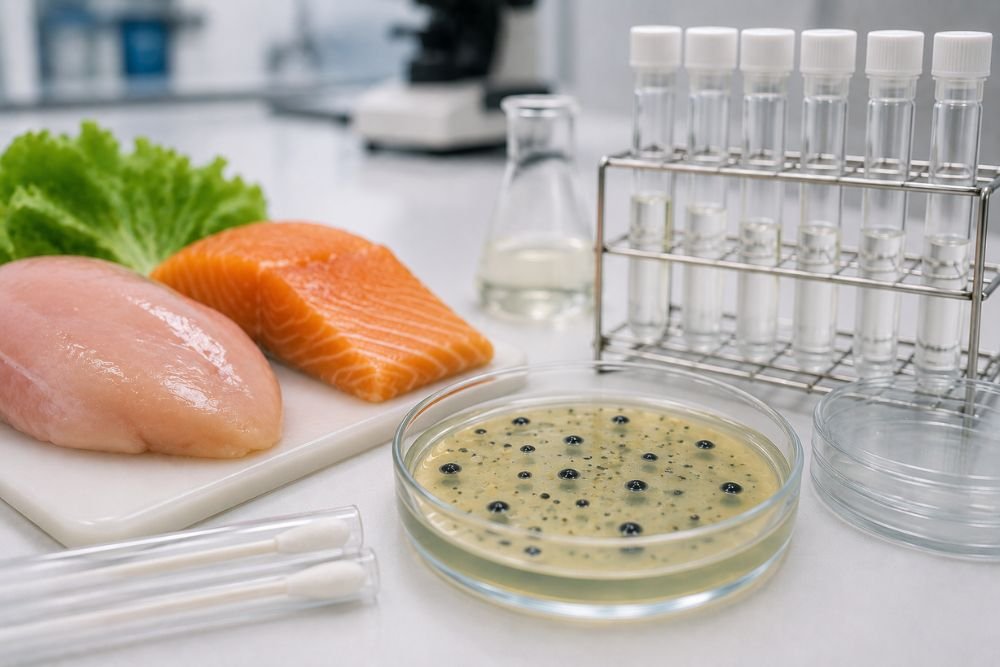
Salmonella remains an important foodborne pathogen that UK food businesses must actively control across sourcing, production, processing and distribution. Working with a reliable Food Testing Laboratory in the UK gives manufacturers, importers, retailers and food service businesses access to laboratory evidence that supports food safety decisions. Through Food Microbiological Testing UK, businesses can assess products for Salmonella and other microorganisms before they reach consumers, helping strengthen compliance, quality control and brand confidence.
What Is Salmonella and Why Is It a Food Safety Concern?
Salmonella is a group of bacteria capable of causing foodborne illness. Contamination can occur through raw ingredients, animals, contaminated water, food-contact surfaces, equipment, poor hygiene or cross-contamination during processing.
Foods associated with Salmonella risk can include eggs and egg products, poultry, meat, dairy products, raw produce, spices, grains and ready-to-eat foods. However, the level of risk depends on the food type, processing conditions, handling practices and intended use.
This is why Food Safety Testing UK should form part of a risk-based food safety programme rather than being treated as a one-time check.
Why Salmonella Testing Matters for UK Food Businesses
For food manufacturers and suppliers, Salmonella testing provides objective evidence that complements hygiene controls and HACCP-based procedures. Salmonella Testing in a Laboratory can analyse representative samples using recognised microbiological methods and provide results that help businesses make informed decisions about product release and corrective action.
Regular testing can help businesses:
- Detect Salmonella contamination before products enter the market.
- Verify the effectiveness of hygiene and sanitation controls.
- Investigate suspected contamination or customer complaints.
- Support supplier and raw-material verification programmes.
- Strengthen batch-release and quality-control procedures.
- Provide documented evidence for customers, auditors and regulators.
Testing does not replace good manufacturing practices. Instead, it provides an important verification layer within a wider food safety management system.
What Does Food Microbiological Testing Cover?
Food Microbiological Testing UK can extend beyond Salmonella. Depending on the product and risk profile, laboratories may assess pathogens and indicator organisms such as Escherichia coli, Listeria, coliforms, Enterobacteriaceae, total viable counts, yeasts and moulds.
METS Laboratories’ UK food-testing service covers a broad range of food categories, including processed foods, beverages, fresh foods, meat and poultry, seafood, eggs, grains and cereals, confectionery, infant foods, oils and condiments, fermented foods and animal feed. Its service page also identifies food-borne pathogen and contamination analysis as part of its testing scope.
This broader approach is important because microbiological risks differ between products. A testing programme for powdered ingredients, for example, may require a different assessment from one designed for ready-to-eat foods or fresh produce.
Which Standards Apply to Salmonella Testing?
The analytical method and microbiological acceptance criteria should be selected according to the food category and applicable requirements.
ISO 6579-1 for Salmonella Detection
ISO 6579-1:2017 specifies a horizontal method for detecting Salmonella in food, animal-feed products and relevant environmental or primary-production samples. The standard remains current and has an applicable 2020 amendment.
For businesses choosing a Salmonella Testing Laboratory UK, it is therefore important to establish which analytical method is appropriate for the specific sample and intended regulatory purpose.
Microbiological Criteria for Foodstuffs
The UK food sector also operates within microbiological criteria derived from Regulation (EC) 2073/2005, with the applicable framework depending on the UK nation and product category. The criteria specify sampling plans, microorganisms, limits and analytical reference methods for relevant foods.
For certain food categories, Salmonella criteria specify absence in 25 g and reference EN ISO 6579. Examples include particular egg products, ready-to-eat foods containing raw egg and various meat and dairy categories. The precise requirement must always be checked against the applicable food category rather than applying one limit to every product.
How Can Businesses Build an Effective Testing Programme?
An effective Food Safety Testing UK programme should be based on the actual hazards associated with the product and process.
A practical approach includes:
- Identify the microbiological hazards associated with raw materials and finished products.
- Define sampling requirements according to product type, production volume and risk.
- Select appropriate analytical methods such as the relevant ISO method.
- Test at suitable stages, including raw materials, in-process products, finished products or environmental samples where appropriate.
- Review results against applicable criteria and product specifications.
- Investigate positive findings and identify potential contamination sources.
- Use trend analysis to identify recurring hygiene or process-control problems.
A competent Food Testing Laboratory UK can help businesses select appropriate testing parameters based on their product and testing objectives.
Why Choose METS Laboratories for Food Testing?
METS Laboratories UK provides food analysis services from its facility in Dudley, England, supporting food businesses with analytical testing across a broad range of food categories. Its published service information highlights microbiological analysis alongside chemical, nutritional, contaminant and authenticity testing.
For businesses seeking Food Microbiological Testing UK, combining Salmonella analysis with wider microbiological, chemical and quality testing can provide a more complete view of product safety and compliance.
Protect Food Quality With Evidence-Based Testing
Salmonella control depends on more than laboratory analysis. Strong hygiene procedures, supplier controls, appropriate processing, environmental monitoring and effective HACCP systems all contribute to reducing contamination risks. Laboratory testing provides the objective evidence needed to verify whether those controls are working as intended.
For UK food manufacturers, importers, retailers and food service businesses, partnering with a competent Food Safety Testing Laboratory UK can support safer products, stronger compliance and greater confidence throughout the supply chain. METS LABORATORIES UK. LTD provides tailored food testing services in Dudley, UK, helping businesses assess microbiological and other food safety parameters according to their product requirements.