

Sunscreen is not just another skincare product. In the UK, it is considered a high-responsibility product because it directly affects how well people protect their skin from harmful UV rays. That’s why brands must be extremely careful about what they print on the label.
Claims like SPF 50+, UVA protection, water resistant, and broad spectrum may sound impressive, but they are not just marketing words.
In fact, these claims must be backed by real evidence. If a sunscreen fails to deliver what it promises, it can lead to customer complaints, negative reviews, loss of trust, and even compliance issues. This is why cosmetic product testing has become a mandatory and essential step for brands selling in the UK market.
In this blog, we will explain how sunscreen testing is done, what labs check, and why claims like SPF and protection cannot be faked when proper testing is carried out.
The Importance of Sunscreen Testing in the UK
The UK skincare market is highly competitive, and customers are more informed than ever. Before buying sunscreen, people often:
- Check ingredients
- Compare SPF ratings
- Look for strong UVA protection
- Read reviews and proof of performance
Because of this, brands must ensure their sunscreen products are safe, stable, and truly effective—not just advertised well.
Sunscreen is used by many types of consumers, such as
- Outdoor workers and sportspeople
- Sensitive-skinned children and teenagers
- Tourists during summer holidays
- People who wear sunscreen daily as part of skincare
Since sunscreen stays on the skin for long hours, cosmetic testing becomes necessary to confirm it is safe and consistent.
Many brands work with cosmetic product testing laboratories to prove product quality before putting sunscreen on store shelves.
What Does SPF Mean (And Why Must It Be Tested)?
SPF stands for Sun Protection Factor. It shows how much protection a sunscreen provides against UVB rays, which are mainly responsible for sunburn.
Here’s a simple comparison:
- SPF 15 blocks about 93% of UVB rays
- SPF 30 blocks about 97% of UVB rays
- SPF 50 blocks about 98% of UVB rays
Even though the difference may look small, it becomes very important during long sun exposure.
However, SPF is not something you can “guess” or claim without proof. It must be measured using proper scientific methods under regulated conditions. That’s why professional cosmetic product testing is the only correct way to verify SPF values before launching in the UK.
Why Sunscreen Claims in the UK Market Can’t Be Fake
In the UK, sunscreen claims are taken very seriously because they relate directly to consumer safety. For example, if a product says SPF 50+ but performs like SPF 20, customers can suffer sunburn and skin damage—and the brand can lose trust permanently.
Today, consumers also prefer brands that offer transparency and real proof. Test reports help brands build credibility and avoid costly mistakes.
Most importantly, working with experienced cosmetic product testing laboratories helps brands:
- Reduce the risk of product failure
- Avoid claim-related legal trouble
- Launch with confidence
When cosmetic testing is done properly, brands can make claims without fear.
Main Sunscreen Tests Done by Cosmetic Product Testing Laboratories
To ensure safety, stability, and performance, sunscreen products go through multiple critical tests. Below are the most common checks performed by professional cosmetic product testing laboratories.
1) SPF Testing (UVB Protection)
This is the most important evaluation. SPF testing confirms whether the product truly performs as:
- SPF 30
- SPF 50
- SPF 50+
Since UVB protection is the main reason customers buy sunscreen, SPF testing is a key part of cosmetic product testing.
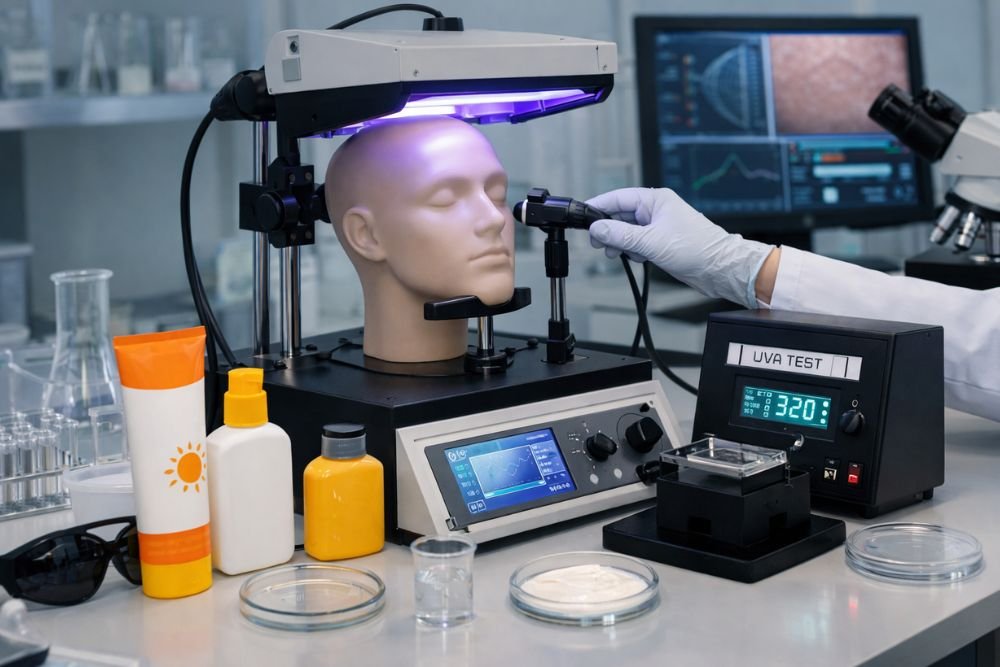
2) UVA Protection Testing
UVA rays penetrate deeper into the skin and can cause:
- Premature ageing
- Wrinkles and fine lines
- Pigmentation and dark spots
- Long-term skin damage
UVA testing proves whether a sunscreen provides strong UVA protection and supports claims like “UVA protected” or “broad spectrum.” This is another reason why cosmetic testing is essential for sunscreen brands.
3) Broad Spectrum Claim Verification
“Broad spectrum” means the sunscreen protects against both UVA and UVB rays. This is a popular claim in the UK market, but it must be supported by real testing results.
Through proper cosmetic product testing, brands can confidently use the broad spectrum claim based on evidence—not assumptions.
4) Water Resistance Testing
Water resistance is a major selling point for:
- Swimmers
- Gym users
- Outdoor workers
But it is risky to claim “water resistant” without proof. Water resistance tests check whether the sunscreen maintains protection even after exposure to water. Many brands include this as part of their full cosmetic product testing plan.
5) Shelf Life and Storage Safety (Stability Testing)
Sunscreen formulas can change over time. Texture, color, scent, and performance can be affected by heat, humidity, or storage conditions.
Stability testing confirms:
- The formula stays stable under heat and humidity
- Texture remains consistent
- Smell and appearance stay normal
- Quality stays reliable until expiry
Stability testing is one of the most valuable parts of cosmetic testing because it ensures long-term performance.
6) Safety Microbiological Testing
Sunscreen is often used outdoors and carried in bags, cars, and bathrooms. This increases the risk of contamination if the product isn’t properly preserved.
Microbiological testing ensures the sunscreen remains safe and hygienic for regular use. This supports both consumer safety and brand reputation.
Why Cosmetic Product Testing is Essential for a UK Launch
Sunscreen is a product people depend on daily. If it fails, customers won’t just feel disappointed—they may experience irritation, sunburn, or long-term skin damage.
Brands that skip proper testing risk:
- Refund requests and customer complaints
- Negative online reviews
- Retail partners rejecting the product
- Damage to brand image
- Compliance and labeling issues
That’s why many brands choose trusted cosmetic product testing laboratories to validate claims and build customer confidence.
How METSLAB UK Helps Sunscreen Brands
At METS LAB, we understand that sunscreen products must be carefully verified before they enter the market. We support brands by checking product performance, safety, and quality using reliable testing methods.
Launching a sunscreen product in the UK requires accuracy, safety, and regulatory compliance. Through Cosmetic Product Testing in UK, brands can verify SPF performance, UVA protection, water resistance, and overall product stability. Each claim must be supported by reliable evidence to meet regulatory standards and maintain transparency with consumers in a highly competitive skincare market.
At METS LAB, we help brands reduce risk and move to market with confidence. Our Cosmetic Product Testing in UK services provide reliable testing and proper documentation, enabling brands to label products accurately, meet market expectations, and build lasting consumer trust.